

2026-05-12
Decoding the Global Automotive Export Map & Opportunities for Used Car Exports
Decoding the Global Automotive Export Map & Opportunities for Used Car Exports
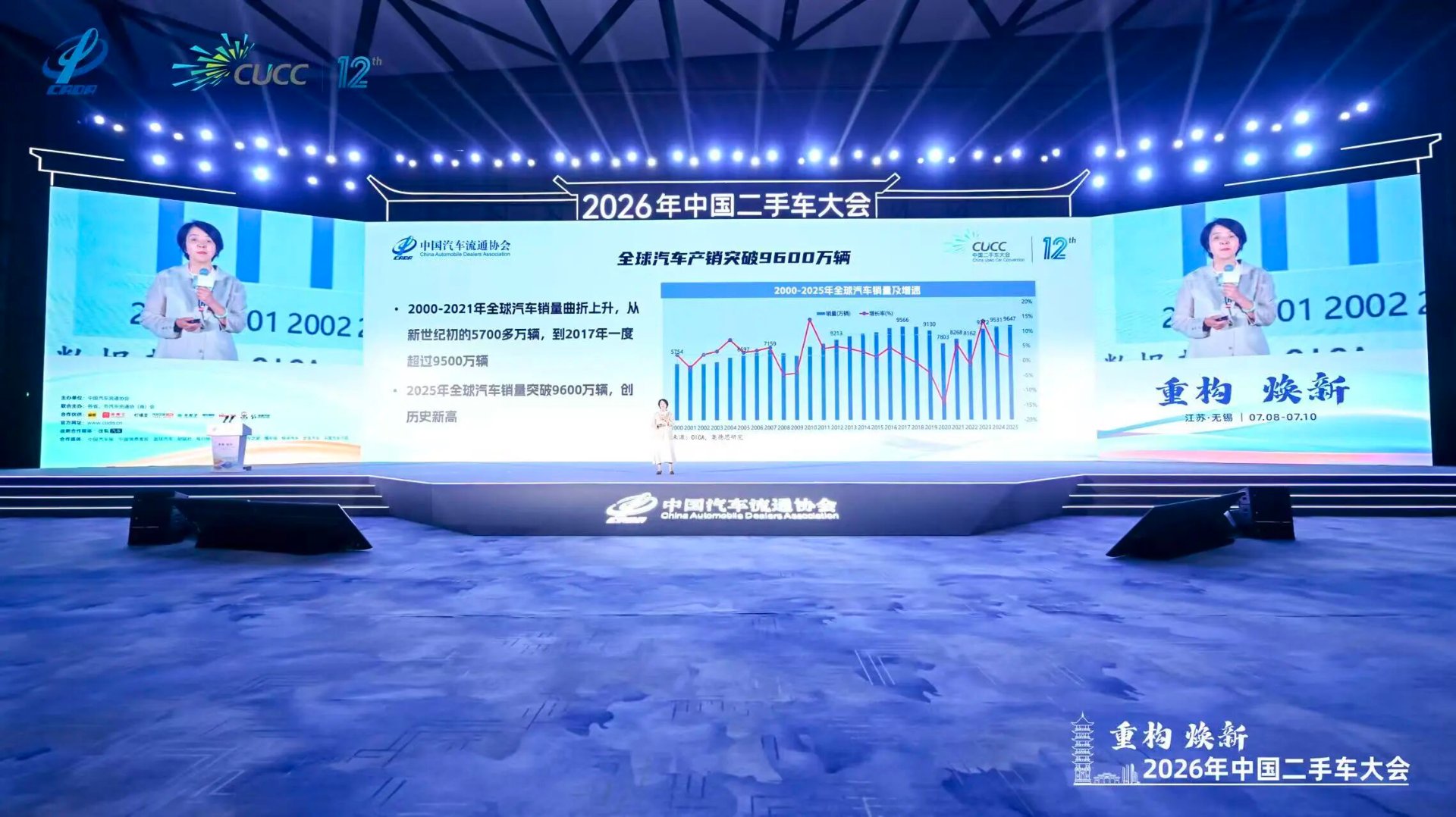
At the main forum of the 2026 China Used Car Conference held in Wuxi, Jiangsu Province, Lang Xuehong, Deputy Secretary-General of the China Automobile Dealers Association (CADA), delivered a keynote titled “Decoding the Global Automotive Export Map and the Opportunities for Used Car Exports.” Drawing on global automotive production and sales data, she deconstructed overseas market segments, analyzed the current state of China’s new-vehicle exports and the competitive landscape of global used-car trade, and identified a critical new window of opportunity for used-car exports — providing strategic guidance for domestic auto enterprises and used-car operators planning overseas expansion.

1. China’s Rising Share in the Global New-Car Market
Lang Xuehong opened with the global new-car market, noting that global new-car sales reached approximately 96 million units in 2025, with an average annual growth rate of about 3%. China’s share of global vehicle production has surged from less than 5% to 35%.
Among the more than 200 sovereign countries globally, approximately 60 countries have annual vehicle sales exceeding 50,000 units, collectively contributing more than 90% of global sales volume. From a regional perspective, four major blocs — North America, the European Union, East Asia, and South Asia — together account for roughly 70% of the global market. However, China’s current export strength remains concentrated in Central and South America, Central Asia, ASEAN, the Middle East, and CIS countries, where Chinese-brand market share has already surpassed double digits.

2. The Right-Hand Drive Market Opportunity
Lang Xuehong specifically highlighted right-hand drive (RHD) markets. Global RHD vehicle sales total approximately 17 to 18 million units annually. While this represents less than 20% of the global total, RHD markets encompass key regions including ASEAN, the United Kingdom, Japan, Australia, and parts of Africa. Currently, domestic used-car enterprises in China have virtually no access to RHD product inventory. To enter these markets, companies must collaborate with OEMs to secure vehicle supply.
17–18 million RHD vehicles are sold globally each year.
This market remains largely untapped by Chinese used-car exporters.
The entry point: OEM partnerships for vehicle sourcing.

3. Global Used-Car Trade Landscape
Global automotive trade totals approximately 35 million units, comprising roughly 28 million new vehicles and 6 to 7 million used vehicles. With China’s increasing participation, the global used-car trade volume is expected to scale to 10 million units.
| Country / Region | Annual Used-Car Exports |
|---|---|
| Japan | ~1.70 million units |
| European Union | ~1.50 – 2.00 million units |
| United States | ~1.20 million units |
| China (2025) | ~750,000 units |
| South Korea | ~500,000+ units |
In the first five months of this year, China’s used-car exports showed a marked divergence: zero-kilometer vehicle exports plunged sharply, while genuine used cars with accumulated mileage grew rapidly. This signals that the industry is returning to the true nature of used-car trade.

4. Destination Markets: Where the Demand Is
Lang Xuehong presented data from United Nations trade and development agencies on used-car export flows from the US, Japan, and South Korea. The global used-car import data reveals the following patterns:
- Africa is the most concentrated region for used-car imports, accounting for over 30% of global used-car trade volume.
- The Middle East and Central Asia follow, with the UAE serving as a major transshipment hub, re-exporting large volumes to Africa.
🇳🇬 Spotlight: Nigeria
As Africa’s most populous nation with over 200 million people, Nigeria has an annual demand for approximately 1 million imported used cars — making it a key target market. The local term for imported used vehicles is “tokunbo.” Lang Xuehong recommended that enterprises monitor local used-car trading platforms to track real-time market pricing and trends.
She also noted that Nigeria hosts roughly 100,000 Chinese nationals and over 1,000 Chinese-funded enterprises, with strong and friendly bilateral relations. Major infrastructure projects are driving demand for both commercial and passenger vehicles, with pickup trucks among the vehicle types well-suited for market entry.

5. Strategic Policy Tailwind: Zero Tariffs for Africa
Effective May 1, 2026, China implemented a unilateral zero-tariff policy for 53 African countries. This will significantly reduce the cost of exporting both used and new vehicles to Africa. Combined with ongoing China-aid infrastructure projects across the continent, this creates a major strategic opportunity for the African market.

6. Strategic Considerations for Market Entry
Lang Xuehong advised enterprises to reference the distribution of Chinese-brand vehicle parc (vehicles in operation) by region when planning their market entry:
| Region | Share of Chinese-Brand Parc | Preferred Powertrain |
|---|---|---|
| Latin America | >20% (highest) | ICE vehicles (limited charging infrastructure) |
| Middle East | ~20% | ICE vehicles (oil-producing economies) |
| Eurasian Union | ~15% | Mixed |
| European Union | ~15% | NEVs (strong policy support) |
| Southeast Asia | Growing | NEVs (policy-driven growth) |
In terms of brands, Chery, BYD, and SAIC lead China’s export rankings. Regarding powertrain preferences: the EU and Southeast Asia show higher NEV penetration due to supportive policies, while Latin America and Africa — where charging infrastructure remains underdeveloped — are dominated by internal-combustion-engine vehicle demand. Middle Eastern oil-producing countries likewise favor conventional energy vehicles. Enterprises must tailor their overseas strategies to regional conditions.
7. Conclusion: From “Going Out” to “Going In”
Lang Xuehong concluded that enterprises should align their overseas expansion with their own resource endowments, reference overseas parc-share data, Chinese-brand export flows, and powertrain-structure differences, and prioritize entry into used-car-importing countries in Africa, the Middle East, and Central Asia. At the same time, she cautioned against the substitution effects of localized new-vehicle production in target markets.
She noted that CADA has already completed in-depth market research on more than 20 countries and will continue expanding country coverage. CADA aims to provide navigational services for the industry, helping enterprises seize the growth window in core markets such as Africa and the Middle East during 2026 — the true inaugural year for used-car exports — and transition from “Going Out” (zou chu qu) to “Going In” (zou jin qu).

📌 Key Takeaways
- ✅ Priority markets: Africa, Middle East, Central Asia — established used-car import pathways with proven demand
- ✅ Right-hand drive markets: 17–18M units/year; OEM partnership required for vehicle sourcing
- ✅ Africa zero-tariff: 53 countries since May 2026 — game-changing cost reduction for exporters
- ✅ Nigeria spotlight: ~1M used-car imports/year, 100K+ Chinese community, strong bilateral ties
- ✅ Real used cars rising: Genuine mileage vehicles are replacing zero-km exports as the industry norm
- ✅ Brand leaders: Chery, BYD, and SAIC top China’s vehicle export rankings
- ✅ Tailor powertrain to region: NEVs for EU/SEA; ICE vehicles for LatAm/Africa/Middle East
- ✅ Localization risk: Monitor substitution effects of localized new-vehicle production in target markets
- ✅ CADA - 20+ countries researched, future export outlook
Translated & formatted for Global Vehicle Mall · July 14, 2026